
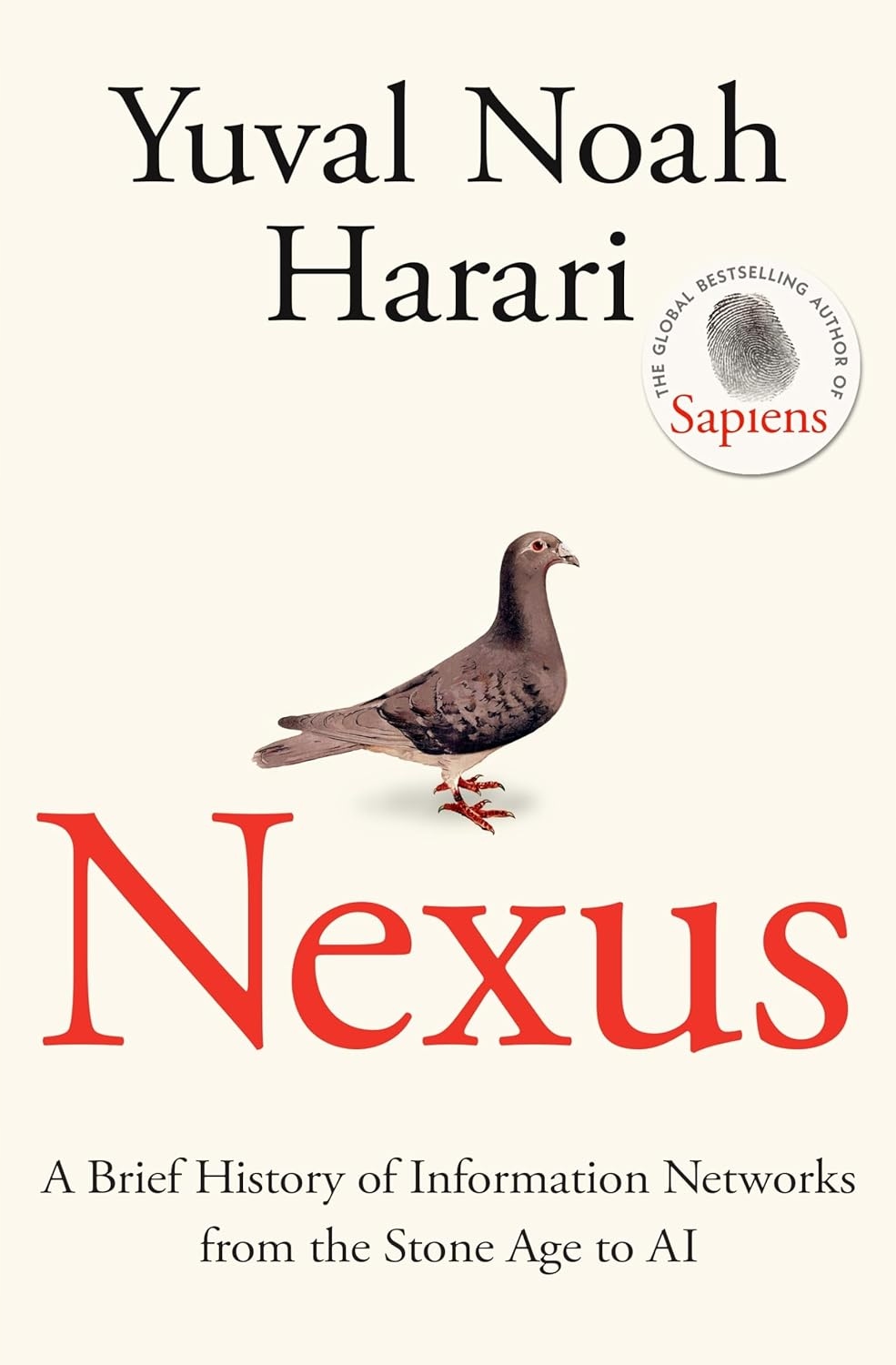
I am preceding the description of the Synthetic Collective Intellect project with a theoretical introduction based on my reading of Yuval Noah Harari’s book “Nexus – A Brief History of Information Networks from the Stone Age to AI.”
The author of this book has a much broader view of information than I do. From the perspective of my project, three threads of this reading are important: intersubjective realities, information as the bond of the network, and truth in the description of reality. I grouped my references to the content of “Nexus” precisely around these three main themes. I developed each of them by dividing them into the observations of Professor Harari that are most important to me.
I structured my study according to the following scheme:
– First, I include a quotation as the guiding idea. In parentheses, I give the page number from the Polish edition of the book.
– Next, I develop it by summarizing the observations of the author of “Nexus” that are important to me.
– Finally, against a gray background, I include my commentary. Sometimes it is a development of the author’s thought, and sometimes it is my own observation. In both cases, my commentary may be contrary to the views of Professor Harari. Only after this page is made public will he be able to familiarize himself with my project and perhaps send me his remarks.
– Every reader has the opportunity to comment on my statements using the form provided for this purpose on the website
Three threads from Nexus that are important for IAI:
- I begin with the subject that is most important to me. Intersubjectivity – it is something I myself was unable to name or define. Reflections on communication between people, truth, and collective consciousness became much simpler once the third—intersubjective—reality was taken into account.
I conclude my reflections on this part with the statement that we are condemned to continually building new intersubjective realities, and that we have only a choice as to what they will be based on. I have my own proposal here. - While working on the model of Integrated Active Information, I defined the concept of the >communication ether<. Unfortunately, in creating this definition I limited myself exclusively to the exchange of information. My definition lacks the >network of cooperation< that is contained in Professor Harari’s concept of the >information network<. As a result, I did not take into account the dual function of information—as the substance of order and truth. I was thinking only about truth.
Reading “Nexus” also made me realize that, at the initial stage of the project, I devoted too little attention to the difference between the functioning of distributed and centralized networks. The type of information network is of fundamental importance in shaping public discourse and may have a major influence on the formation of intersubjective realities. Perhaps in the future I will still be able to complete this aspect of the project.
Thanks to this book, I also became aware of the significance of information technologies such as → religion and bureaucracy. I understood that my idea of an Active Integrated Information Structure had grown to the scale of an information technology, which the Synthetic Collective Intellect may become. - Truth is a concept important in the evaluation of information, but it is also a concept to which we often assign an almost mystical meaning, and for that reason it has ceased to be unambiguous.
I began my work on the IAI project with the search for truth [which I defined at the end as Broad Synthetic Truth], but once I found it, it turned out that it was not the most important thing after all.
I conclude my reflections with a polemic against Professor Harari: perhaps Google’s mission is not entirely naive.