
BA-15
Decision-making process based on single-currency and dual-currency loan agreements
The decision whether to take out a loan and what type of loan to choose depends mainly on the price of the loan, about which every borrower should be clearly informed by the bank before signing the agreement.
To estimate the price of a loan, it is enough to compare two values: how much money we will receive in a specific currency and how much we will have to repay in that same currency. The condition that both values be given in the same currency is crucial here, because it is not possible — in a simple way — to unambiguously estimate the price of a loan if the currency of disbursement and repayment are different, and provisions concerning the price should be understandable to every borrower who can read, add, and multiply.
I will analyze whether the provisions in a dual-currency agreement are readable to an ordinary person from the perspective of the financial consequences resulting from signing that agreement. For this purpose, I will compare a loan agreement in zlotys, in a foreign currency, and indexed (valorized) to a foreign currency. I will check how many elements of the agreement the borrower had to combine into one whole and what knowledge the borrower had to possess in order to make a calculation that determines the price of the loan and allows them to choose the best loan offer.
Below I present three diagrams concerning three decision-making processes — a zloty loan (A), the choice between a zloty loan and a foreign-currency loan (B), and the choice between a zloty loan and a dual-currency loan (C). I have marked in them the data necessary to calculate the price of the loan and the documents generated by the bank that should reflect this calculation.
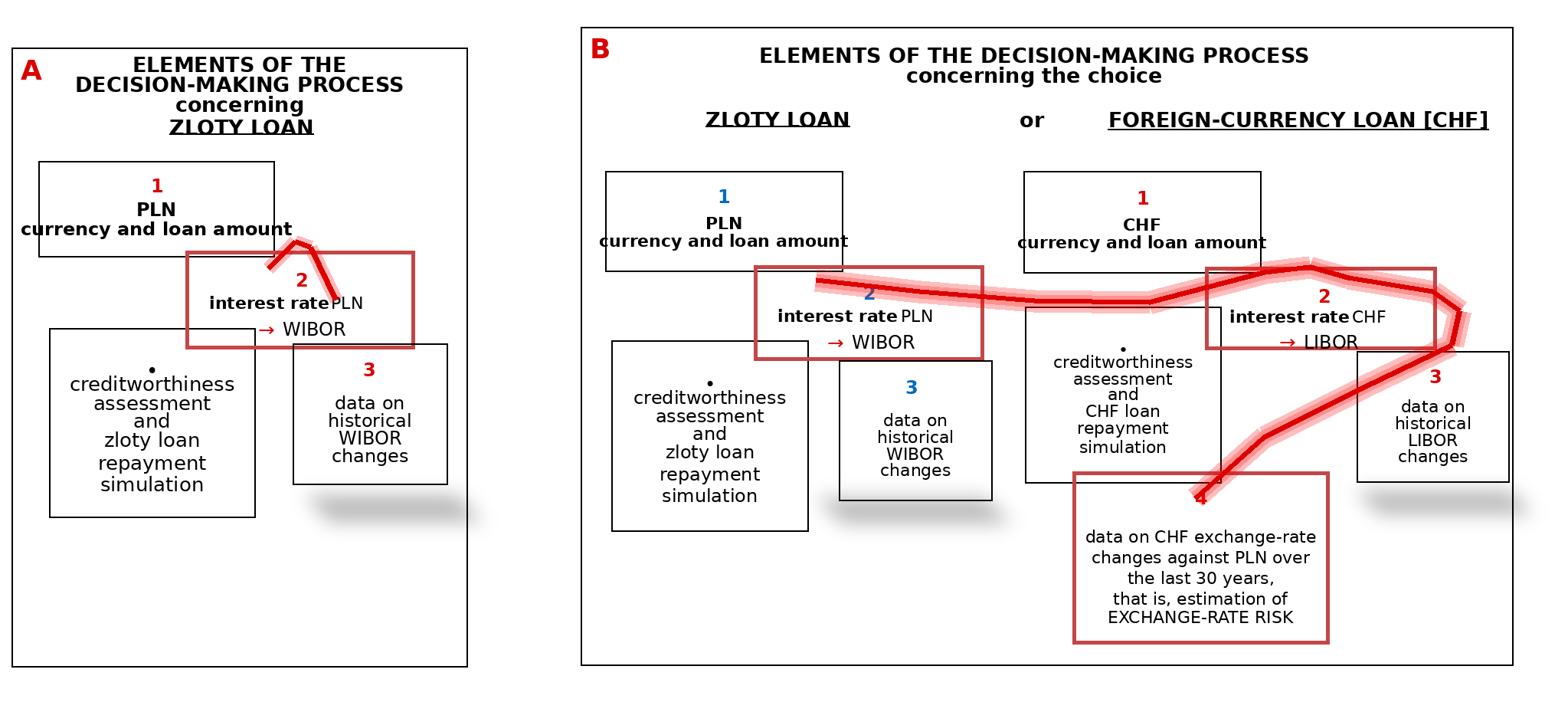
A – In the case of a zloty loan agreement, the information important for such a calculation is the amount of capital and the interest rate, which are clearly recorded in two paragraphs of the agreement, as well as the range within which the interest rate may change. The financial consequences of signing the agreement can be understood on the basis of one simple mathematical operation, namely calculating interest on the borrowed capital. Of course, calculating all the interest precisely over 30 years of loan repayment is a time-consuming task, which is why the consumer should receive such a simulation from the bank before signing the agreement.
B – In the case of comparing loan offers: a zloty loan and a foreign-currency loan (e.g. in CHF), in addition to the interest rate for each currency and the range within which these interest rates may change, one more important parameter appears — currency risk, that is, how much the foreign-currency exchange rate may increase in the currency in which our debt to the bank has been defined. Here the consumer should compare two loan simulations and take into account the risk of an increase in the foreign-currency exchange rate, and information about the range within which this exchange rate may change should also be received from the credit adviser, who could have estimated it on the basis of data from the last 30 years, to which the bank certainly has access. Of course, any risk of a significant change in the foreign-currency exchange rate discourages a potential borrower from this form of loan.
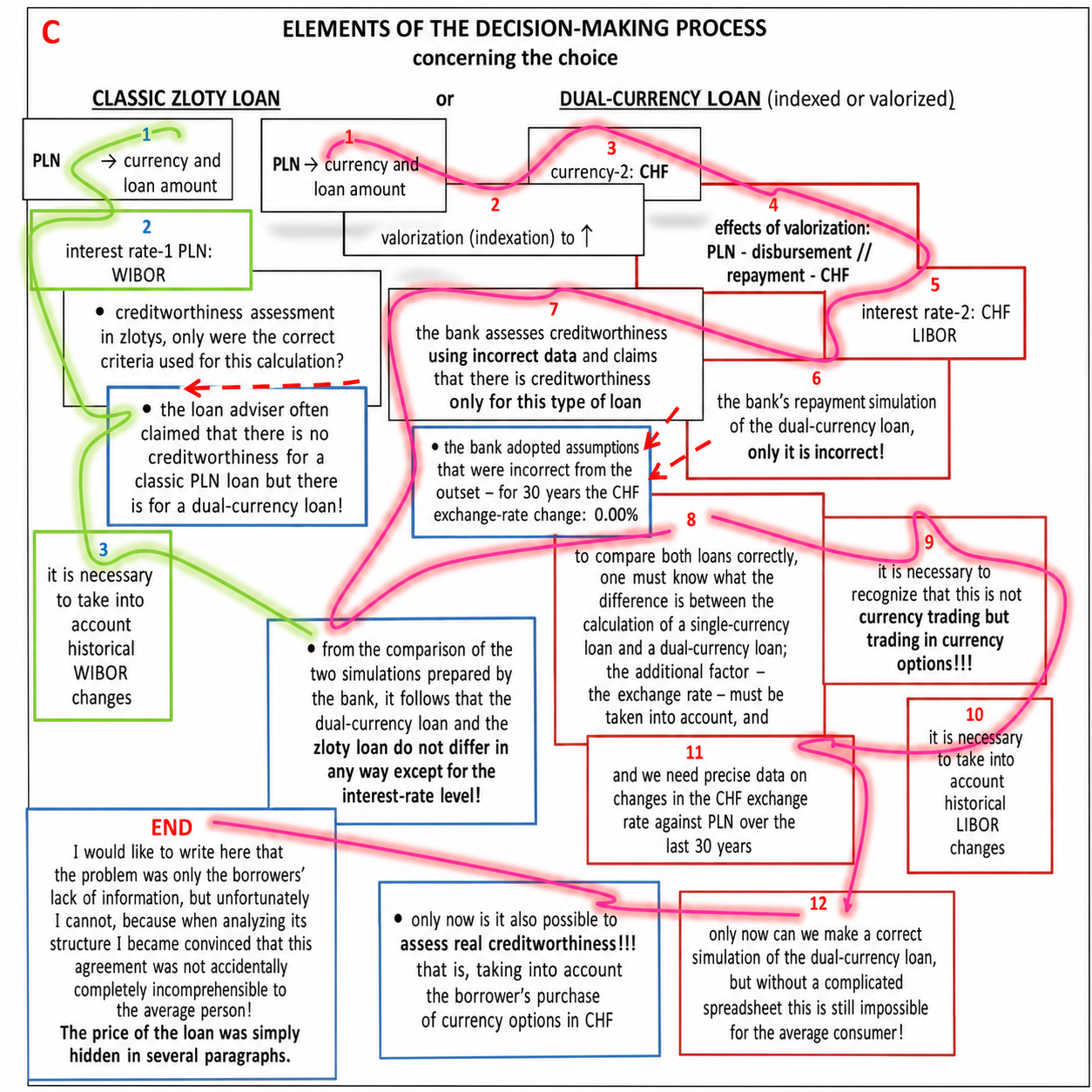
C – The structure of an agreement indexed (valorized) to a foreign currency is frighteningly complex. One must begin by stating that this is a zloty loan only valorized to a foreign currency, which means that right at the beginning of the agreement there appears an unclear provision that no one knew from their own experience (attempts to analyze this type of agreement began appearing in the media only after the first major jump in the Swiss franc), and everyone who took out this loan could only guess what it meant. To calculate the price, it is not enough to understand only the provision concerning the interest rate, as credit advisers claimed, thereby misleading borrowers. Understanding the consequences of the provisions of a dual-currency agreement requires a detailed and professional analysis of the entire agreement, because the provisions concerning the price of the loan are hidden in various corners of it.
It is also worth adding here that banks provided borrowers with a lot of additional information that turned out to be false, and it was not trivial. For example, that CHF is called a “safe currency”, which is true, but this does not mean at all that its exchange rate only fluctuates slightly by 2–3% up and down and that, over several decades, it will be almost the same, as credit advisers claimed.
No state supervision checked whether banks were properly assessing creditworthiness for dual-currency loans, and most banks claimed that they could grant only this type of loan because there was insufficient creditworthiness for a zloty loan.
No supervision also questioned their dual-currency loan repayment simulations, that is, the most important document in assessing a loan offer, although a specialist should have noticed at first glance that it was incorrect, because the currency exchange rate in it remained the same for 30 years, meaning that it suggested the exchange rate was not of major importance here, while in fact the opposite was true — the probability of a large increase in the franc exchange rate against the zloty in the long term was so high that it was practically certain. It is enough to look at charts of the franc exchange rate against other currencies over the previous thirty years. Bankers had them at hand, but an ordinary Kowalski did not. Here is the increase in CHF value against currencies such as: USD-167%, GBP-162%, PLN-400%.
The bank analysts drafting the agreement added to an ordinary agreement several additional financial operations, about which an ordinary Kowalski had only a vague idea — there is supposed valorization or supposed indexation, supposed currency trading, a much better loan interest rate, but there is no information that the borrower is acquiring currency options and that their debt may increase by 100%, or perhaps by 200% or 300%.
To sum up – dual-currency borrowers received an unreadable agreement in which the price of the loan was not properly defined, along with false information concerning the absence of exchange-rate risk and the competitive interest rate of the loan.
For a consumer borrowing money from a bank, there was only one difference between a zloty loan and a dual-currency loan — the interest rate, because they were unable to independently estimate the true cost of a dual-currency loan, since:
– they did not know what such a calculation should contain,
– they did not have the necessary data for it, and
– it was simply too complicated.
At most, they could sense that something in the dual-currency agreement did not quite fit, but intuitions are absolutely useless when making a price calculation. The decision to take out a loan is made within a few weeks at most, not over several years — and that is how long it took for the truth about dual-currency loans to be revealed.
I leave the comprehensive study to the specialists who will edit this page. Above, I have included only my observations.